GPT-6 Astra Went Viral, and I Think I Just Saw a Rift Open Up in Time
In the weekend GPT-6 Astra launched, everyone started driving Blender, Houdini, Unity and Aseprite with AI. Computer Use is turning the GUI into the most universal API of the agent era — execution is losing its scarcity, yet judgment is forged inside execution. An essay on the rift opening up in our time.
GPT-6 Astra Went Viral, and I Think I Just Saw a Rift Open Up in Time
GPT-6 Astra Access in China
| Channel | URL | Best for |
|---|---|---|
| All-model API aggregator | https://tryallapi.com/ | Developer calls, low-latency direct connection, one-stop multi-model access |
| High-speed GPT mirror in China | https://trygpt.asia/list/#/home | Browser-based chat without a VPN, lightweight workflow testing |
| Official top-up channel | https://chongzhi.trygpt.asia/ | Removing the overseas payment barrier, direct top-up to your official account |
| MomoAI monthly plans | https://momoai.asia/home | Heavy users who prefer a monthly subscription |
GPT-6 Astra officially launched this weekend. And then social media and every group chat went absolutely wild. My X timeline was almost entirely GPT-6 Astra. Or more precisely: it was all videos of people driving software with GPT-6 and producing completely absurd things.
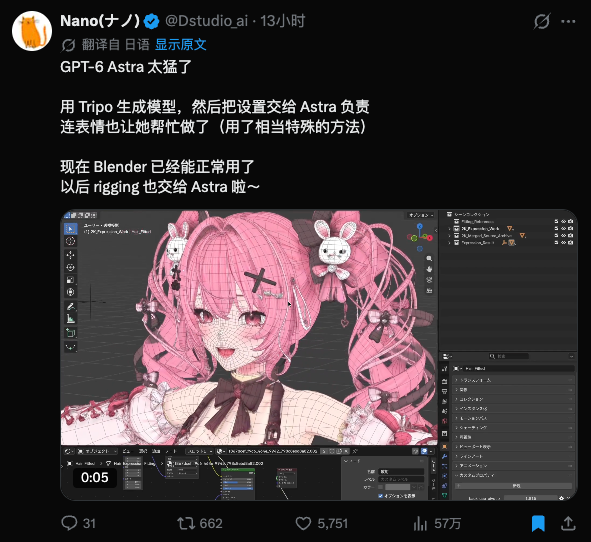
Like using Astra to generate a 3D model on Tripo, then importing it into Blender (a professional 3D suite) and letting Astra take over — assembling it, rigging expressions, and so on…
Caption: GPT-6 Astra generating and manipulating a 3D model via Tripo and Blender.
Then there's my good friend @Astreo, who had GPT-6 Astra drive Houdini to animate a model — and yes, you read that right, Houdini, one of the most notoriously professional tools out there, is something Astra can now operate directly…
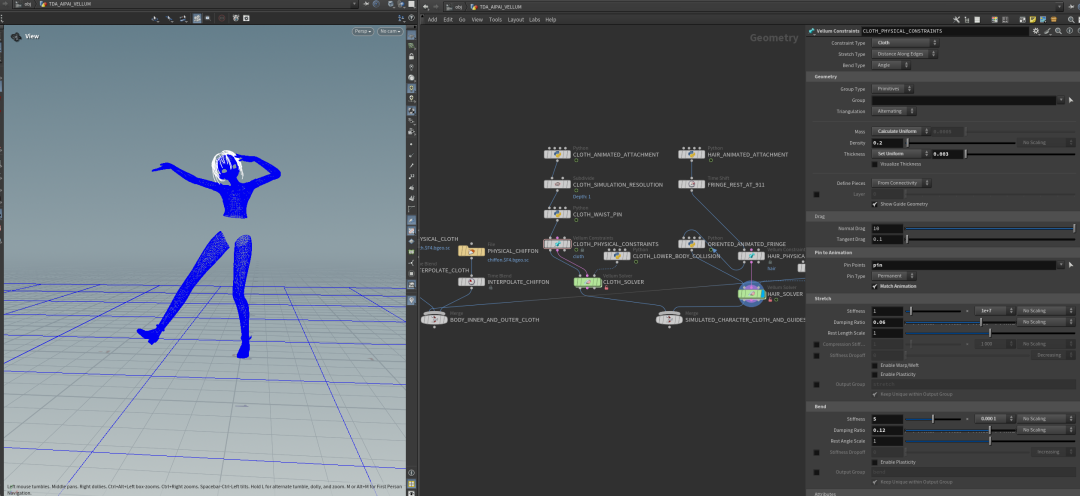 Caption: GPT-6 Astra driving Houdini to animate a model.
And the finished piece looks like this… My friend Minister Huang used Astra to drive Blender and recreate another creator's video — then recolored it five different ways.
There's another video recreating a scene inside Blender.
And another creator used Astra to drive Blender and Unity to build a small game demo.
 Caption: GPT-6 Astra driving Blender and Unity to build a game demo.
Sure, it's just a tiny demo. To a real game developer, it's probably not some grand achievement. But you have to understand what indie developers went through in the past.
Astlibra (《神之天平》), a game I absolutely love, was made by a single person, KEIZO, working alone — and it took the most precious 15 years of his life.
 Caption: The cover of Astlibra.
Fifteen years. For one game. And even then, its art and level design were extremely rough — a huge amount of the original assets came straight from free asset packs, free images, and assets donated by various different artists. Most of the music was free Japanese background-music material too.
Later, Shigatake — the Vanillaware artist who worked on masterpieces like 13 Sentinels: Aegis Rim — happened to step in out of pure love for the project and redrew a massive portion of the art. Only then did the game become barely presentable.
But the script and the gameplay were so strong that countless people still hail it as a masterpiece.
More than once while playing Astlibra I've thought with a pang of regret: if KEIZO had made this in the AI era, if he'd had a model like GPT-6 Astra in his hands — How high could Astlibra's ceiling have gone?
Sadly there are no ifs in life. Those 15 years passed in the blink of an eye.
And that is exactly why GPT-6 Astra being able to autonomously drive Blender and Unity into a playable game demo matters so much.
Beyond that demo, there's @Anshu, who built an even more polished one — entirely modeled by Astra driving Blender.
Beyond game modeling, there's Astra driving Aseprite (the go-to software for pixel art and 2D pixel animation) to draw pixel-style art…
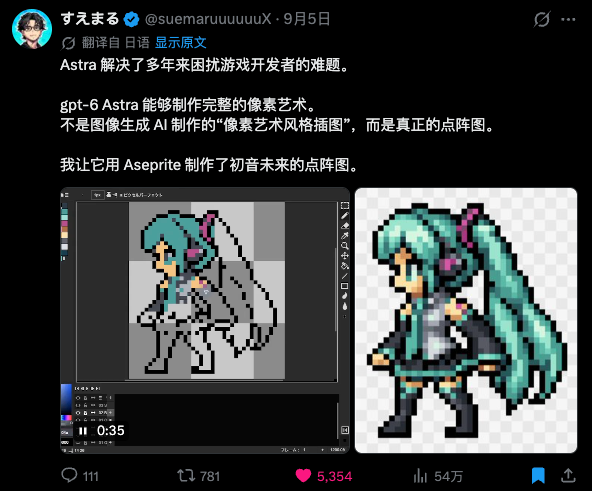 Caption: GPT-6 Astra driving Aseprite for pixel art.
And Astra coloring line art.
The vibe across the whole internet these past two days is something I haven't felt in a very long time. It's a bit like when GPT Image 2 first launched.
And a bit like when Nano Banana first launched.
Everyone suddenly entered that state of: WTF????? You can DO that????
And of course, the most staggering case of all: someone had Astra rebuild the Palace of Fine Arts in San Francisco inside Blender…
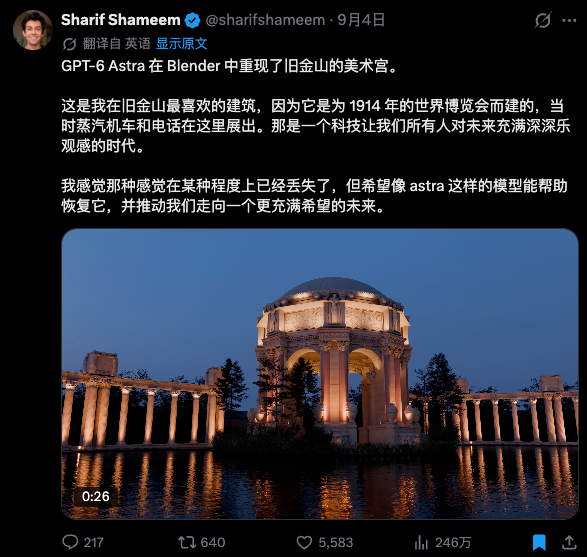 Caption: GPT-6 Astra rebuilding the Palace of Fine Arts in Blender.
I have to show you the original video.
It went online and searched hundreds of reference images by itself, kept adjusting the model, rendered intermediate frames, then compared its render against the references and kept revising.
It even dug up an old scanned document from the U.S. Library of Congress and found the real measurements of the building's columns.
The author only corrected it a handful of times along the way.
Things like: the sky color is a bit off, some geometry is clipping through other geometry.
But the overwhelming majority of the work was done by Astra overnight, running by itself.
Then the author woke up the next morning — and the finished render was sitting on his desktop.
Some say this might be the arrival of a new Renaissance.
Honestly, there are so, so many more cases I could list. More than you can imagine. Human creativity and ideas are just that abstract and abundant. It's even possible that "using AI to operate professional software" becomes a new kind of benchmark.
Humanity has, over the past few decades, already built an enormous digital civilization. Blender already contains complete 3D capability. After Effects already holds decades of accumulated motion graphics and compositing. DaVinci already has full video editing. And on and on.
All of that capability was already there. You could happily model, apply materials, render, rig bones, paint weights — and a month later, out comes a rendered animation. But all of it has one prerequisite: You have to know how to use it.
That sounds like a tautology, but there's an unimaginable GAP and barrier hidden inside it.
Think back: how many professions built their moat precisely on this? I'm worth more than you because I've used this software for five years — I know all those messy features, and my hotkeys are lightning fast.
We still get résumés all the time that read: proficient in PowerPoint, Excel, Word, JianYing; can reliably produce short-video scripts with Doubao and DeepSeek; tried C4D modeling; used AE for some VFX, blah blah blah.
That's the reality.
In a sense, for decades, society — an entire era — had something very thick sitting between professional capability and ordinary people.
I thought about it for a while and found one phrase that captures it precisely. I call it: Execution ability.
And GPT-6 Astra has directly made all execution ability meaningless on any visible time horizon.
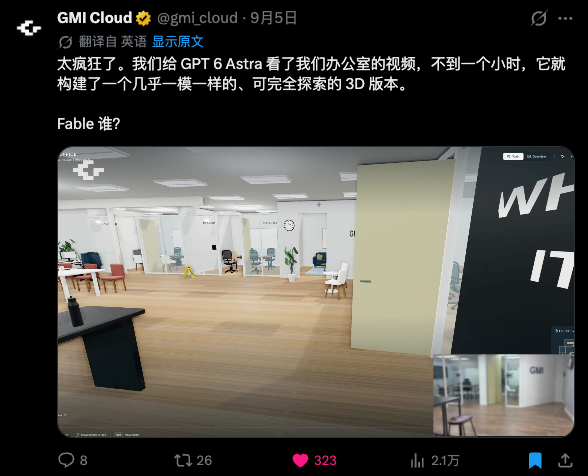
So what if you know Houdini? So what if you're a C4D wizard who can pull a box into something carved like a flower on a pile of — fine, you're skilled. So what? AI seems to click faster and more accurately than you do. Hand it a video and it'll reconstruct the scene for you inside a 3D package.
 Caption: GPT-6 Astra reconstructing a scene in 3D software from a video.
It's still a bit rough right now, but this is just like LLM coding ability back in 2024. Give AI another six months or a year — once its reconstruction reaches the limits of a top-tier human, once it can play It Takes Two with you in real time — I doubt we'll still be laughing about it.
You should believe this: all high cost, all latency, all slowness will be solved by AI's progress.
All of this comes from Computer Use. From the generalization of GUI operation.
A lot of people say GUI doesn't matter in the agent era. I don't agree.
Which is why, in my last piece on GPT-6, I wrote one line:
The GUI may gradually become the most universal API of the agent era.
Put another way, the real significance of the GUI is that it adds an AI-compatibility layer over all the software capability humanity has accumulated over decades — just like the most suitable form factor for embodied intelligence today happens to be the human body.
GPT-6 Astra is as if it suddenly turned the entire human software world into its own toolbox. An industrial package with five thousand buttons.
Some company's ERP written in-house in 2008.
An architecture tool nobody ever built an AI interface for.
You don't need to change a thing. I'll just use you as you are.
And it's plainly visible that the way AI capability grows may change. We used to think: what if AI can't do 3D? Simple — train a dedicated 3D model.
AI can't do circuit boards? Easy — train a specialized PCB model.
Now there might be a far more brute-force approach.
Humans already have software that does it, don't they? So just let AI learn the software. Who needs to train a separate model?
Decades of accumulated capability from the software industry — that's the real treasure.
Which also explains why OpenAI is hoovering up tens of thousands of Mac Minis and stuffing them into their data centers for model reinforcement learning.
When GPT-6 Astra dropped a few days ago, I was genuinely anxious — because I'm not just a blogger, I also run a company of thirty-some people. So I wrote this passage. It may read a bit preachy, but it was a real reaction to being hit by the sheer generality of GPT-6 Astra.
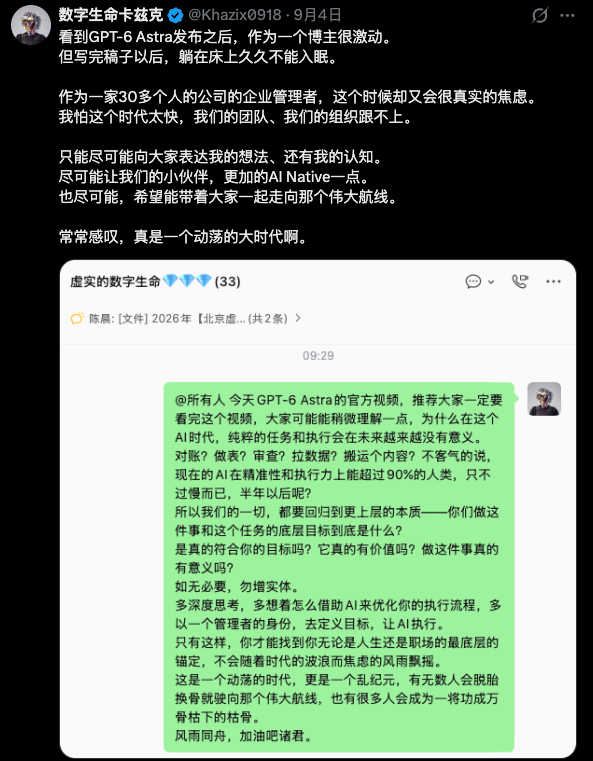 Caption: The author's reflections on being shaken by GPT-6 Astra's generality.
One line in it said: "Pure task execution will increasingly lose meaning in the future."
Written in an anxious state, that was probably a bit extreme. Thinking it over later, I believe the more accurate phrasing is:
The act of execution is losing its scarcity.
Execution still matters, of course.
That model in Blender still has to be built by someone. That animation in AE still has to be keyed by someone.
But the one performing those execution steps no longer has to be a human.
So we're entering a very strange state.
The distance between the intent in your head and the result appearing on your screen is shrinking fast.
That distance used to be extremely valuable — it was the moat and barrier of most professions.
But now, operational knowledge itself has lost its scarcity.
And so the act of execution has lost its scarcity too.
Which is why I believe the value of many professions will be forcibly split into two layers:
Judgment, and execution ability.
Take a 3D designer.
In the past, understanding 3D + knowing Blender (as an example — reality obviously demands far more tools) were two layers of professional value, tightly welded together.
Going forward, they'll gradually decouple.
Whether you can skillfully operate Blender — that's not important at all anymore. It's meaningless.
But whether you know the underlying knowledge of 3D: are the proportions right, is the space comfortable, should this material be swapped for something with more texture to match the piece's tone, does this composition actually look good — those judgments will only grow in importance.
Yet for countless people, an entire career was spent training themselves to use their own flesh and blood, through the act of execution, to shorten the distance between intent and the result on screen.
The tide of the era rolls forward. It waits for no one and pities no one.
Just like these two classic images.
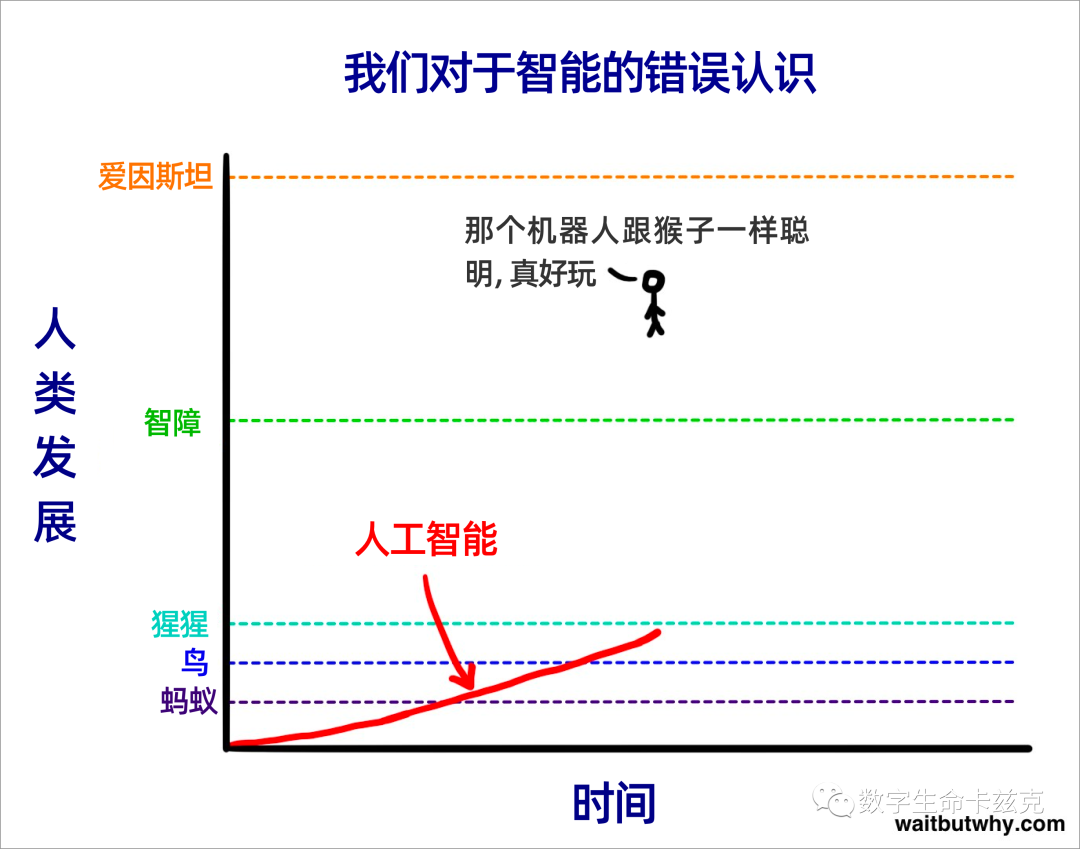 Caption: A classic illustration on AI and human development.
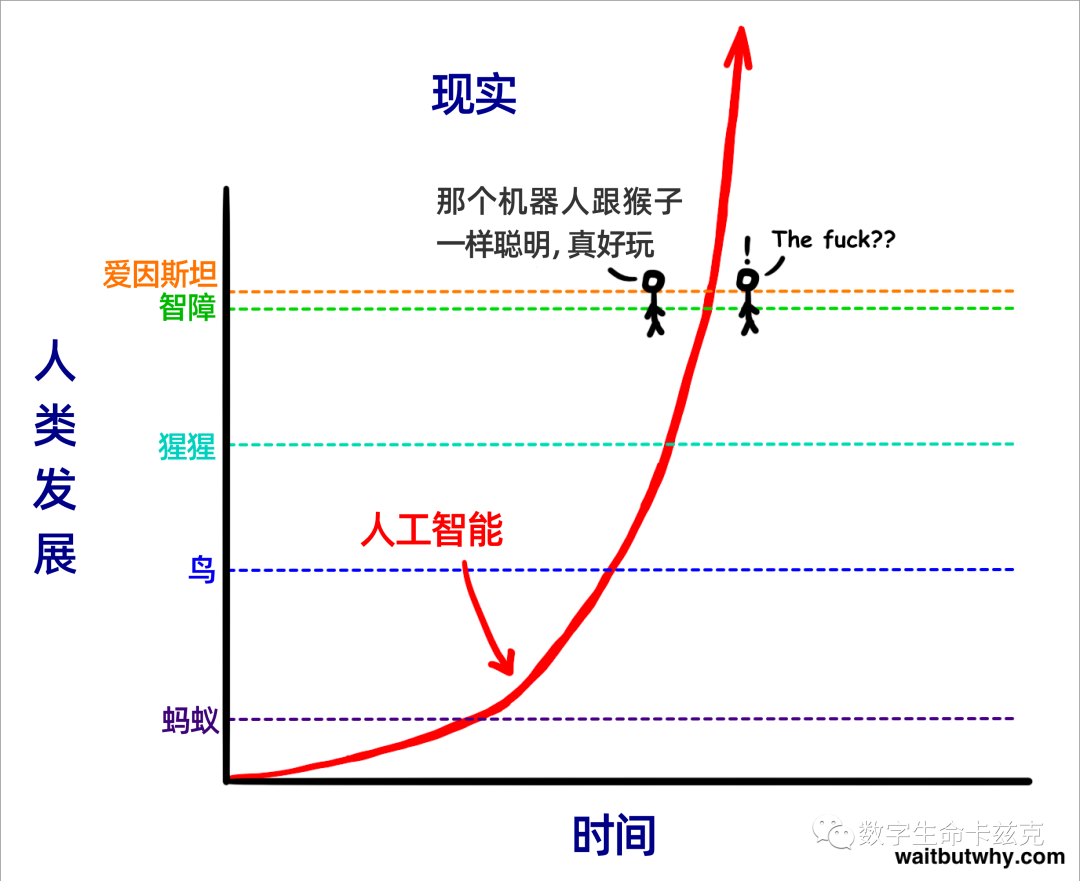 Caption: A classic illustration on reality and AI development.
This is also, I think, one of the things most worth watching about how professions change.
Knowing Blender doesn't mean you understand 3D.
Knowing AE doesn't mean you understand animation.
Knowing CAD doesn't mean you understand architecture.
Knowing Excel certainly doesn't mean you understand finance.
It's just that, because the execution barrier used to be so high, these things got bundled together. That's all.
But now comes the saddest part. And in my view, the single most contradictory thing about this world, this era.
If execution ability is meaningless, then the most important thing is judgment.
So here's the question.
Where does that judgment actually come from?
Regrettably.
Judgment grows almost entirely through one path: from inside those very execution tasks that AI is now steadily devouring — a human steps in, and grinds it out task by task, little by little, through real work.
Why does someone who's genuinely used Blender for ten years take one look at Astra's model and know where it might be wrong? Obviously — because they've made too many.
Why can someone who's danced to Brother Kun's routines for ten years spot at a glance that your "Iron Mountain Lean" isn't authentic? Obviously — you have no idea how many times they practiced that move in private.
Most of the time, they can't even articulate why.
Because it has become instinct.
And what we call instinct is probably the residue of tens of thousands of executions, tens of thousands of failures, tens of thousands of revisions — compressed and left behind inside the brain.
Just like me, slow as I am: my understanding of AI and of content came from nearly three and a half years of writing, 685 original articles, accumulated bit by bit.
And so something deeply paradoxical appears.
The economic value of execution is depreciating fast.
Yet many of humanity's most valuable abilities were trained by execution.
GPT-6 saves you five years of operating Blender. Great.
But inside those five years, was there anything besides hotkeys and buttons?
Yes. There was.
You looked at countless models. You broke countless models.
You redid things countless times because of your own dumb mistakes.
And slowly you learned:
Oh, this is what good looks like. Oh, this is what bad looks like.
What looks impressive but is actually unusable.
AI can compress five years into five minutes.
But the real question is this:
Results can be compressed.
Can human growth be compressed along with them?
I don't know.
And that is why I said earlier: this is the most contradictory and sorrowful thing about this world, this era, right now.
So the best companies and education systems of the future will probably all have to answer one question — the question I've been turning over lately:
Which friction should AI eliminate.
And which friction must remain for humans.
One of the things AI is best at is helping us bypass pain.
But the infuriating part is:
A great many human abilities grow precisely inside that pain.
In the human world, there has always been a very great word: inheritance.
I'm afraid that one day, when the likes of us old-timers really are old, really are ready to retire —
We'll want to hand over the mantle we hold.
We'll turn around.
And find no one standing behind us.
That, too, feels like an enormous sorrow.
That's all. Since you made it this far — if you liked it, tap like, wow (在看), share — the triple combo. Want updates the moment they drop? Give me a star ⭐. Thanks for reading — see you next time.
/ Author: Kazike
/ For submissions or tips: wzglyay@virxact.com